

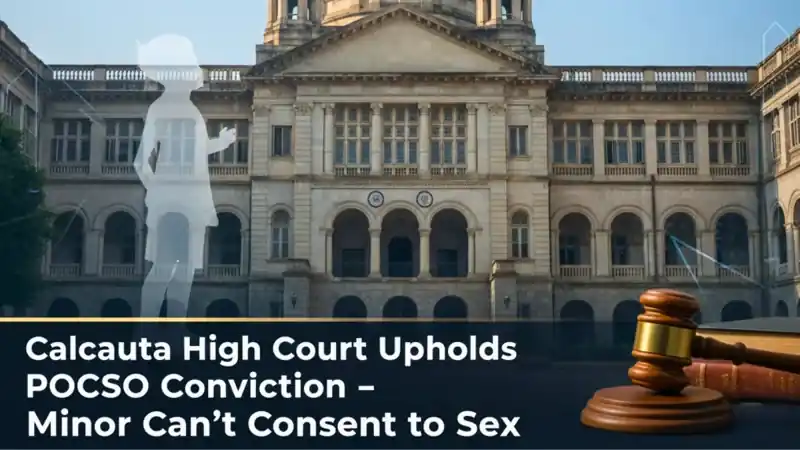
Minor cannot consent to sex, the Calcutta High Court reaffirmed while upholding the POCSO conviction of a man who claimed he had a “love affair” with a minor girl but later refused responsibility after she became pregnant. Reiterating that a minor cannot legally consent to sexual activity, the Court held that any claim of consensual relationship or emotional involvement cannot absolve the accused under the POCSO Act.
Calcutta High Court Reaffirms: “Minor Cannot Consent to Sex”
In a significant judgment that reinforces India’s strong statutory protections for minors, the Calcutta High Court upheld the conviction of a man under the Protection of Children from Sexual Offences (POCSO) Act. The accused had argued that the relationship with the minor was voluntary and based on “love,” but the Court emphasized that consent from a minor holds no legal validity under POCSO. The case once again highlights how Indian courts interpret claims of relationships involving minors and the legal consequences that follow.
Background of the Case
The case originated when a minor girl became pregnant, allegedly due to her relationship with the accused. Following the pregnancy, the man disowned responsibility, refusing to acknowledge the child or provide any form of support. This triggered a complaint by the victim’s family, leading to formal investigation and subsequent prosecution under the POCSO Act, which criminalizes all forms of sexual activity with individuals below 18 years of age—regardless of alleged consent.
The trial court had earlier convicted the accused based on medical evidence, the victim’s testimony, and the sequence of events proving sexual involvement. The accused appealed to the High Court, claiming the relationship was mutual, and therefore, the conviction was unjustified.
Salman Khan Delhi High Court Personality Rights Case
Minor Cannot Consent to Sex: Court’s Key Findings
The Calcutta High Court dismissed the defense argument and upheld the conviction, stressing three major findings:
1. Consent of a Minor Is Legally Meaningless
The Court reiterated that the POCSO Act considers all sexual contact with minors as statutory sexual assault, irrespective of claims of love, affection, or emotional attachment. No minor can legally consent to sex, and no alleged love relationship can override statutory protection.
2. Pregnancy Strengthens the Evidence
The High Court noted that the minor’s pregnancy served as a crucial piece of evidence indicating sexual involvement. The accused’s denial of responsibility further strengthened the prosecution’s case, showing lack of accountability and corroborating wrongdoing.
3. Protection of Children Is Paramount
The judgment emphasized the legislative intent behind POCSO:
to protect children from exploitation, coercion, manipulation, and abuse—even in situations where they themselves may not fully understand or resist the consequences.
By upholding the conviction, the Court reinforced that adults must bear full responsibility for their actions when minors are involved.
Legal Significance of This Judgment
This ruling is consistent with a series of judicial decisions across India where courts have reaffirmed that minors do not possess the capacity to understand or give meaningful consent to sexual relationships. Such judgments serve several crucial purposes:
- Preventing the normalization of “romantic relationships” with minors
- Holding adults accountable for exploitative or predatory behavior
- Strengthening the legal framework around statutory sexual assault
- Ensuring victims receive justice even when emotional manipulation is involved
The decision contributes to a growing body of case law ensuring strict implementation of POCSO provisions.
Broader Context: Trend in Indian Courts
In recent years, courts across India—including the Delhi, Bombay, Karnataka, and Madras High Courts—have repeatedly clarified that:
- A minor’s agreement cannot be used as a defense
- Emotional narratives, such as “love affairs,” cannot dilute legal accountability
- Pregnancy, medical reports, and victim testimony hold strong evidentiary value
- Protecting minors must override all other considerations
The Calcutta High Court’s ruling aligns with this national judicial trend and reaffirms that the welfare and protection of minors remain paramount.
Conclusion
The Calcutta High Court’s decision to uphold the POCSO conviction is a powerful reminder of India’s zero-tolerance approach toward sexual offences involving minors, reaffirming the principle that minor cannot consent to sex. By rejecting the argument of a consensual relationship and highlighting the illegality of sexual involvement with minors, the Court has once again reinforced the core objective of the POCSO Act: protecting children from exploitation and ensuring justice for vulnerable victims.
The case also underscores the judiciary’s role in safeguarding minors in an evolving society where emotional manipulation, digital influence, and false promises often blur boundaries. The ruling sends a clear message — any adult who engages in sexual activity with a minor will face strict legal consequences, regardless of claimed consent or emotional involvement.
Sources: