
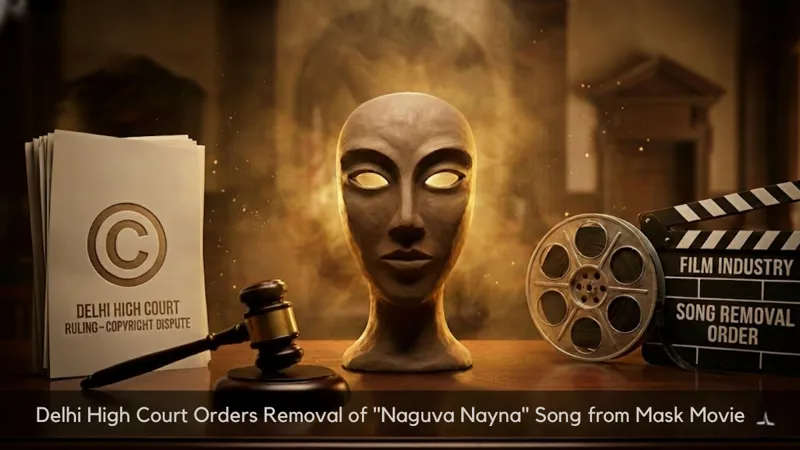
In a notable development in India’s entertainment and copyright landscape, the Delhi High Court has issued a strict directive to the makers of the Tamil film Mask. The court has ordered the production team to remove the copyrighted Kannada song ‘Naguva Nayana’—owned by music label Saregama—or compensate the rights holder with Rs 30 lakh.
This decision has sparked discussion across the film industry, particularly around copyright compliance and the use of vintage songs in modern cinema.
Why the Case Reached Court
The controversy began when Saregama India Ltd., one of the country’s oldest and largest music rights holders, filed a complaint stating that the song Naguva Nayana had been used in Mask without obtaining any authorization.
About the Song
‘Naguva Nayana’ is an iconic track from the 1980 Kannada film Pallavi Anu Pallavi, directed by Mani Ratnam with music composed by Ilaiyaraaja. Saregama holds the exclusive copyright to this music and alleged that the Mask team reproduced the track without entering into a licensing agreement.
Background: Where the Song “Naguva Nayana” Actually Comes From
The disputed track “Naguva Nayana” does not belong to the upcoming Tamil film Mask.
It is actually a classic Kannada song from the 1983 film Pallavi Anu Pallavi, which is notable for being Anil Kapoor’s first-ever lead role in Indian cinema.
The movie was directed by Mani Ratnam, marking his directorial debut, with music composed by legendary composer Ilaiyaraaja. The song is widely remembered for its soothing melody, emotional depth, and Ilaiyaraaja’s signature orchestration. Over the years, “Naguva Nayana” has become a cultural favorite among Kannada music listeners.
Because the rights to the song are owned by Saregama India Ltd, any reproduction, remix, or reuse requires official licensing. The Delhi High Court case arose when the Mask filmmakers allegedly incorporated this classic track into their movie without securing the required rights.
This historical context highlights why Saregama reacted strongly and why the court took the matter seriously—the song is not just old music; it is a copyrighted cultural asset tied to a well-known film and a major Bollywood actor’s early career.
Court’s Findings and Decision
During the hearing, the court reviewed Saregama’s claims and noted that the producers of Mask had not secured permission to use the copyrighted song. The Delhi High Court emphasized the following:
- Copyrighted music cannot be used in films, trailers, or promotional content without a valid license.
- Unauthorized usage directly harms the rights holder.
- Strict action is necessary to prevent the growing misuse of old and popular songs in new productions.
The Order
The court issued a clear directive:
Remove the song from the film OR pay Rs 30 lakh as damages.
This gives the filmmakers limited options—either re-edit the film and replace the track or compensate Saregama before release.
Impact on ‘Mask’ Movie
The film, starring Kavin and Andrea Jeremiah and directed by Vikarnan Ashok, has been generating early buzz. However, the court order now requires the production team to revisit their post-production process.
If the producers choose to remove the song, it may delay the movie’s release schedule. If they opt to pay the damages, it will significantly increase the cost of production.
Industry Reaction
Copyright disputes involving film music are not new, but this case draws attention due to:
- The increasing reuse of classic songs in modern films.
- The expansion of digital platforms, which makes copyright enforcement stricter.
- The financial risks filmmakers face when using unlicensed content.
Experts say this judgment reinforces the need for producers to follow copyright protocols diligently.
What Happens Next
The filmmakers have not yet issued an official statement. The industry is now watching closely to see whether they will remove the song or pay the penalty.
Either way, the case highlights the importance of respecting intellectual property rights in the Indian film industry.